Fault Detection and Classification (FDC) Market growth is driven by industrial automation, predictive maintenance demand, AI/ML analytics adoption, IoT integration, and the need to reduce downtime and operational costs.
Austin, Jan. 27, 2026 (GLOBE NEWSWIRE) — Fault Detection and Classification Market Size & Growth Insights:
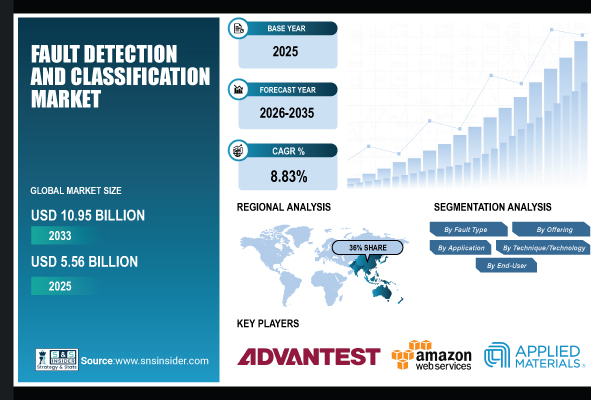
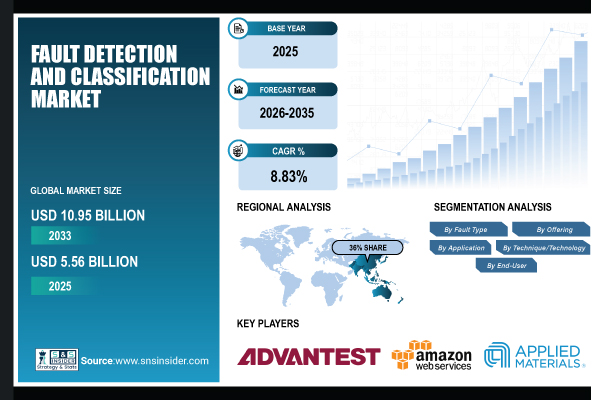
According to the SNS Insider, “The Fault Detection and Classification Market size was valued at USD 5.56 billion in 2023 and is expected to grow to USD 10.95 billion by 2033 and grow at a CAGR of 8.83% over 2026-2033.”
Quality Control Improvements through Digital Transformation is Boosting the Market Growth Globally
Since businesses want to boost productivity, cut down on mistakes, and enhance quality control, automation in manufacturing is a major factor in the growth of the fault detection and classification (FDC) market. Automation has reduced human involvement in jobs linked to inspection and problem detection by transforming many traditional manual procedures into data-driven systems. Companies are using sensors, data analysis, and AI analytics to swiftly detect and resolve possible issues as they monitor manufacturing activity in real time using sophisticated FDC technology. AI-powered FDC systems reduce errors and enhance overall product quality by more precisely identifying inconsistencies than manual inspections. By analyzing past data using machine learning algorithms, these systems enable proactive maintenance by anticipating possible equipment problems.
Get a Sample Report of Fault Detection and Classification Market Forecast @ https://www.snsinsider.com/sample-request/4033
Leading Market Players with their Product Listed in this Report are:
- ADVANTEST CORPORATION
- Amazon Web Services, Inc.
- Applied Materials, Inc.
- CIM Environmental Pty Ltd.
- Cognex Corporation
- einnoSys Technologies Inc.
- INFICON
- KILI TECHNOLOGY
- KLA Corporation
- Microsoft
- MobiDev
- OMRON Corporation
- Qualitas Technologies
- SAMSUNG SDS
- Siemens AG
- Synopsys, Inc.
- Teradyne Inc.
- Tokyo Electron Limited
Fault Detection and Classification Market Report Scope:
| Report Attributes | Details |
| Market Size in 2025E | USD 5.56 Billion |
| Market Size by 2033 | USD 10.95 Billion |
| CAGR | CAGR of 8.83 % From 2026 to 2033 |
| Report Scope & Coverage | Market Size, Segments Analysis, Competitive Landscape, Regional Analysis, DROC & SWOT Analysis, Forecast Outlook |
| Key Segmentation | • By Fault Type (Dimensional Fault, Surface Defects, Contamination Faults, Process Variability, Others) • By Technique/Technology (Sensor Data Analysis, Statistical Methods, Machine Learning Algorithm, Others) • By Offering (Software, Hardware, Services) • By Application (Manufacturing, Packaging) • By End-User (Automotive, Electronics and Semiconductor, Metals & Machinery, Food & packaging, Pharmaceuticals) |
Purchase Single User PDF of Fault Detection and Classification Market Report (20% Discount) @ https://www.snsinsider.com/checkout/4033
Key Segmentation Analysis
By Offering
Based on offering, Hardware has become the leading segment in the Fault Detection and Classification (FDC) market, accounting for 60% of total revenue in 2025E. This substantial percentage highlights the importance of tangible elements in fault detection systems such as sensors, controllers, and diagnostic tools. Hardware is essential for fault detection systems, as it plays a crucial role in supporting the monitoring, data acquisition, and real-time analysis of equipment performance.
By End-User
In 2025E, the Electronic and Semiconductor industry dominated the Fault Detection and Classification (FDC) market, holding a 31% market share. This importance highlights the sector’s crucial requirement for advanced fault detection systems to uphold the reliability and performance of electronic devices and semiconductor manufacturing processes. The demand for advanced FDC solutions is fueled by the rising intricacy of electronic components and the precision needed in semiconductor manufacturing.
Regional Insights:
In 2025E, Asia Pacific emerged as the top competitor in the Fault Detection and Classification (FDC) market, capturing a 36% share of revenue. The primary reasons for this control are the strong industrial sector in the area, fast technological progress, and growing funding in automation and smart technologies. Different manufacturing and industrial sectors such as automotive, electronics, and semiconductor industries can be found in the Asia-Pacific region.
The FDC market in North America is witnessing fast growth as the second region, driven by notable technological progress and acceptance in numerous industries. The area’s expansion is fueled by its strong industrial structure, a focus on innovation, and significant investment in automation and predictive maintenance technologies.
High Implementation Costs May Impede Market Expansion Globally
One of the biggest obstacles is the high implementation costs, particularly for small and medium-sized businesses (SMEs). A significant financial investment in hardware, such as sensors, data collection tools, and computer infrastructure, is required to implement FDC systems. Additionally, businesses with less funding might have trouble hiring the skilled workers needed to use machine learning and AI-driven analytics. The cost of maintenance and upgrades may cause the cost-conscious industries to adopt these systems more slowly.
Do you have any specific queries or need any customized research on Fault Detection and Classification Market? Submit your inquiry here @ https://www.snsinsider.com/enquiry/4033
Recent Developments:
- In March 2023, Samsung SDS launched an AI-powered FDC solution for transportation. The solution is designed to help transportation companies detect and classify faults in vehicles & infrastructure, improving safety and efficiency.
- In August 2023, Synopsys, Inc. launched Synopsys Software Risk Manager, a powerful new application security posture management (ASPM) solution. Software Risk Manager enables security and development teams to simplify, align and streamline their application security testing across projects, teams and application security testing (AST) tools.
Exclusive Sections of the Fault Detection and Classification Market Report (The USPs):
- TECHNOLOGY & ANALYTICS ADOPTION METRICS – helps you understand the share of fault detection solutions based on sensor data analysis, statistical techniques, and machine learning algorithms across industries.
- FAULT TYPE COVERAGE & CAPABILITY ANALYSIS – helps you evaluate solution effectiveness in identifying dimensional faults, surface defects, contamination issues, and process variability in production environments.
- DEPLOYMENT MODEL & OFFERING MIX METRICS – helps you assess the market split between software-based, hardware-based, and service-based fault detection and classification solutions.
- INDUSTRY ADOPTION & APPLICATION PENETRATION METRICS – helps you gauge demand from manufacturing and packaging sectors and adoption levels across automotive, electronics & semiconductor, and food industries.
- MARKET STRUCTURE & FINANCIAL PERFORMANCE METRICS – helps you analyze revenue growth trends, market concentration of leading players, and average deployment costs by industry.
- OPERATIONAL PERFORMANCE & DEFECT REDUCTION METRICS – helps you benchmark fault detection accuracy, defect reduction rates, and time required to identify and classify faults on production lines.
About Us:
SNS Insider is one of the leading market research and consulting agencies that dominates the market research industry globally. Our company’s aim is to give clients the knowledge they require in order to function in changing circumstances. In order to give you current, accurate market data, consumer insights, and opinions so that you can make decisions with confidence, we employ a variety of techniques, including surveys, video talks, and focus groups around the world.
CONTACT: Contact Us:
Rohan Jadhav - Principal Consultant
Phone: +1-315 636 4242 (US) | +44- 20 3290 5010 (UK)

Disclaimer: The above press release comes to you under an arrangement with GlobeNewswire. IndiaShorts takes no editorial responsibility for the same.