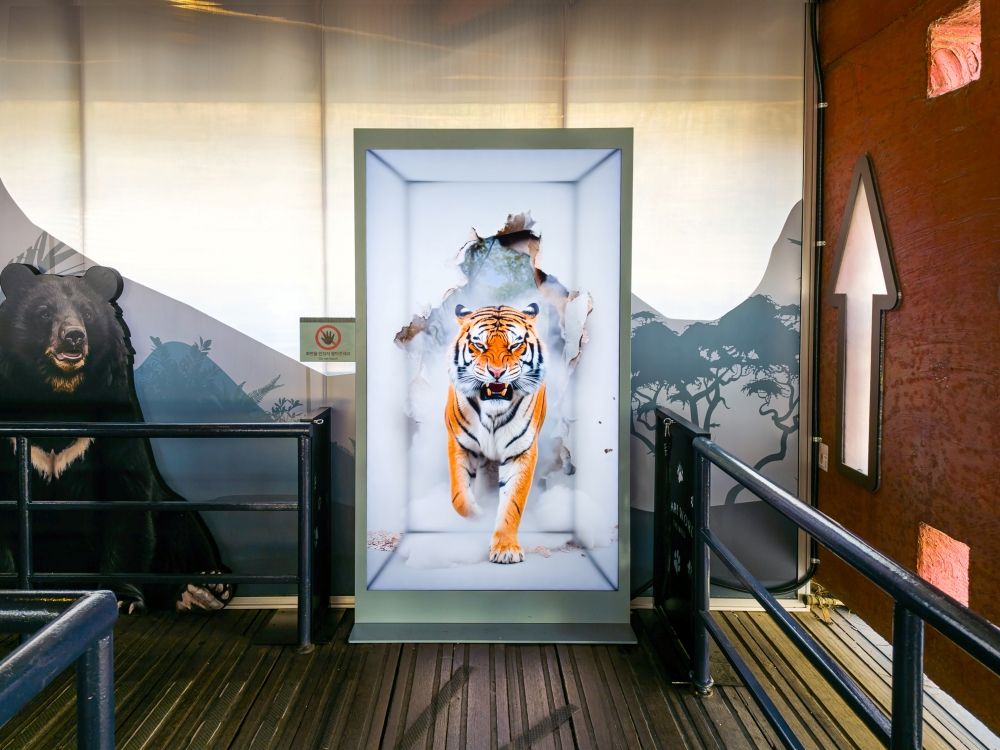
As visitors queue for ‘Safari World: The Wild’ at Everland, Korea’s largest theme park in Yongin, Gyeonggi Province, they encounter a captivating experience that turns the wait into part of the safari adventure. On a life-sized display, realistic tigers and lions appear to leap from the screen, intensifying the excitement before the safari begins.
Samsung Electronics has installed its glasses-free 3D display, Spatial Signage, at the newly revamped Safari World at Everland, enriching the visitor experience. Utilizing Samsung’s patented 3D Plate technology, the display offers impressive depth and realism without 3D glasses, all in a slim 52-millimeter design.
Samsung Newsroom visited Everland to observe how Spatial Signage enhances the waiting experience and gathered visitors’ reactions to the immersive display.
Before the safari tour commences, visitors are welcomed by animals brought to life on Spatial Signage. The vibrant movement and three-dimensional effect increase the feeling of immersion, heightening anticipation for the adventure ahead.
“Following Safari World’s reopening as a reimagined ecological space with improved animal welfare, we aimed to unify every aspect of the guest experience—from entry and waiting lines to the safari bus ride,” said Jiyeon Bae, Leader of Partnership & Alliance Group, Resort Business Division at Samsung C&T. “Spatial Signage was seen as the best method to lead guests into the safari adventure.”
Bae explained, “To evoke the atmosphere of a wild expedition, we placed large-scale animal artwork featuring life-size bears, lions, and tigers along the waiting route. Extending that visual experience with Spatial Signage, which gives the animals vivid dimensionality, further enhanced visitors’ sense of immersion.”
The display, despite its large 85-inch size, offers significant flexibility in installation. “Considering the characteristics of the waiting area, we designed a custom frame that seamlessly integrates with Safari World’s environment, allowing us to position the display naturally within the queue,” Bae added.
Visitors responded enthusiastically to the glasses-free 3D experience, which transformed the mood of the waiting area. Instead of merely standing in line, they interacted with the animals, took photos, and made the wait part of the fun.
One visitor, who came with family, remarked, “It felt like real animals were moving right in front of us. Taking photos with the kids while waiting made the time fly by.” A student on a field trip noted, “I thought you needed glasses for 3D, but the tiger looked so real when it seemed to break out of the screen.”
A couple in the queue shared, “Seeing the wild animals we are about to meet truly built anticipation for the safari. It feels like we’ve already stepped into the safari before even getting on the bus.”
SeungHyuk Jin, CEO of Klleon, the content development company, emphasized the role of Spatial Signage as an innovative interface. “Spatial Signage goes beyond delivering information—it enables visitors to directly experience the space,” Jin said. “We focused on capturing the natural movement of the animals and creating a sense of spatial depth so visitors are immediately immersed in the world of safari while waiting in line.”
At Everland’s Safari World, Samsung Spatial Signage shapes the identity of the space and adds a new layer of immersion to the visitor journey. With innovations like Spatial Signage, Samsung continues to set the standard for immersive and engaging display experiences across industries.