
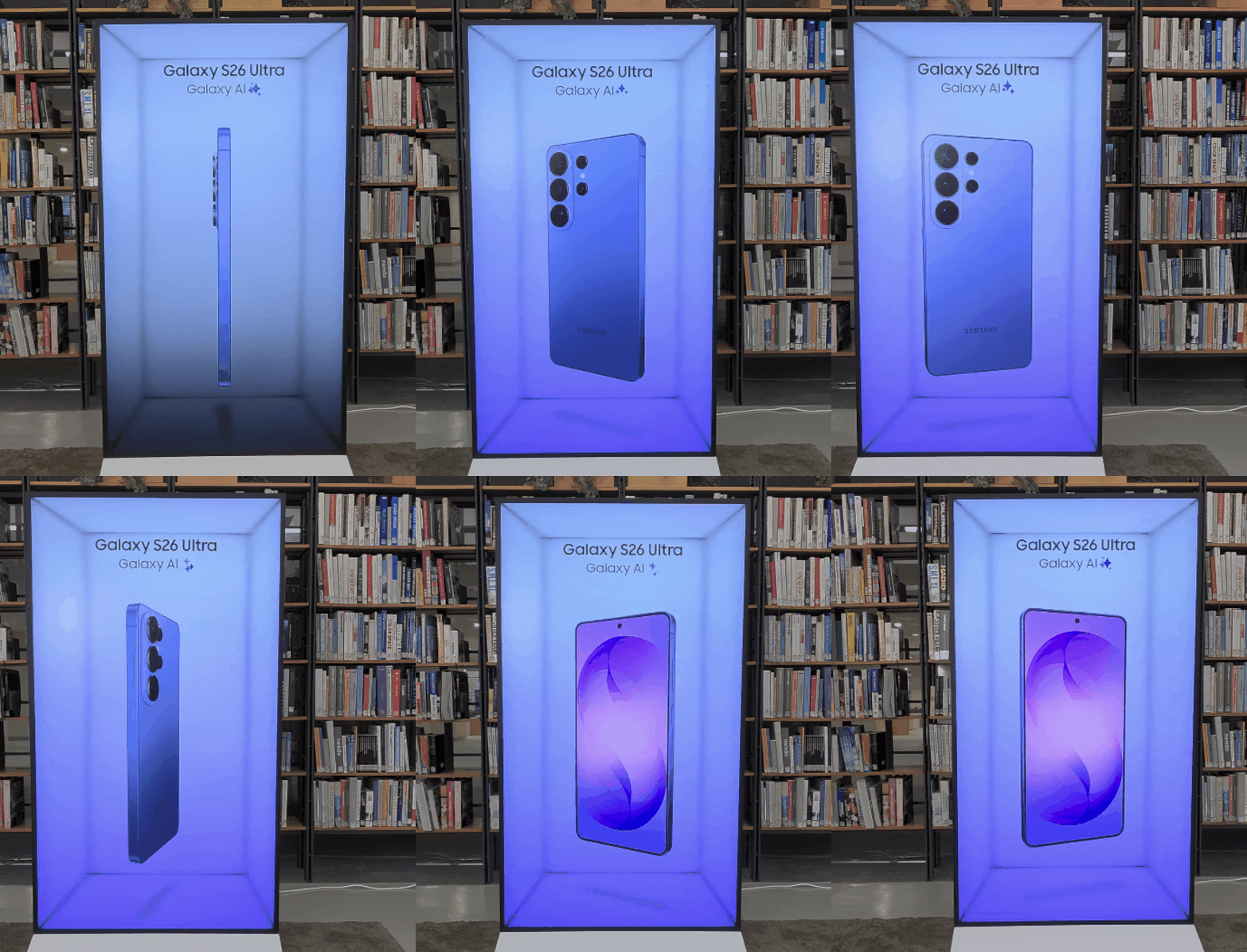
At Integrated Systems Europe (ISE) 2026, held in Barcelona this February, Samsung Electronics’ booth featured an eye-catching installation. This display, only 52 mm thick, showcased objects appearing to float in midair and rotate 360 degrees without the need for 3D glasses.
Samsung’s glasses-free 3D display, known as Spatial Signage, has received accolades at prominent events such as IFA 2025, CES 2026, and ISE 2026. The development of this technology was a collaborative effort involving Samsung’s display, research, and design teams, each contributing to solving the 3D display puzzle.
Samsung Newsroom interviewed several experts within the company, including Jong-Gu Sun and Yujin Nam from the Visual Display Business, Chang-Kun Lee from Samsung Research, and Eun Vit Chung from the Corporate Design Office, to discuss the innovation journey.
Redefining the 3D Visual Experience
As the demand for distinctive visuals increases, there is a growing need for new display solutions. “We are observing a rising interest in visually striking content that captures attention, such as ultra-large LED-based anamorphic displays,” said Sun. “However, these installations usually require more space than traditional signage and dedicated 3D content.”
“Spatial Signage offers immersive 3D depth without glasses or large holographic boxes, providing unique experiences in various environments,” he added. “It also lowers the cost of producing dedicated content while being compatible with existing signage systems.”
Turning this concept into reality required a robust technological foundation. “While exploring new signage solutions, we identified advanced display technology in development at Samsung Research that could enable 3D signage for B2B environments,” said Chung. “From that point, close collaboration among SR, CDO, and the VD Business advanced the technology and brought it to market.”
Inside the Technology Behind Spatial Signage
At the heart of Spatial Signage is 3D plate technology. “The system combines a display with optical components to send separate images to each eye, using the principle of binocular disparity so the brain perceives depth,” explained Lee. “A lenticular card, which shows different images depending on the viewing angle, is a common example of a 3D plate.”
“Spatial Signage employs a new method of rendering 3D images to overcome the limitations of conventional glasses-free 3D displays, such as reduced image quality and narrow viewing angles,” he added. “By presenting the main subject in high-resolution 2D while using a 3D plate to create depth in the background, it achieves both immersion and high image quality.”
Building an ultra-large, 85-inch 3D display presented challenges. A 3D plate is created by combining lenticular lenses with printed images to produce 3D visuals, and once made, it cannot be adjusted.
“If discrepancies between design specifications and the actual structure are not precisely accounted for, the background on screen can appear distorted,” said Lee. “To address this, we developed a special pattern to detect errors during lens production.” By combining this printed pattern with the lenticular lens, the team could quickly identify deviations and adjust printing conditions accordingly.
Securing depth while maintaining a slim profile was another challenge. Spatial Signage uses a thin 3-4 mm 3D plate to create a box-like sense of space with a perceived depth of up to 500 mm, as if extending inside the screen. “Achieving depth with such thin optical materials made lens design and reliability testing difficult,” Nam explained. “Despite numerous unexpected obstacles, we explored a range of ideas and ultimately improved the product’s quality.”
The team also faced physical limitations. “With an ultra-large 3D plate, gravity can cause sagging, leading to blemishes or distortions, while vertical lenses can produce the moiré effect — a high-frequency, wave-like pattern,” said Nam. “We repeatedly encountered these technical constraints. It would not have been possible without close collaboration across teams.”
Crafting Depth Through Design
With the technology in place, the next step was to design an intuitive and immersive visual experience. “To maximize depth on the 85-inch screen, we refined the 3D plate imagery and developed guidelines for image processing that enhance elements such as perspective and shadows,” Chung emphasized. “It is the result of years of accumulated expertise and dedication.”
As a result, the 3D plate features precisely calculated lines, surfaces, and gradient backgrounds, while the foreground 2D content incorporates lighting, shadows, and perspective aligned with the background’s depth. “This project felt like bringing virtual images from a 3D program into the real world,” said Chung. “I’ve grown attached to each visual element created through this process.”
However, implementing the concept proved more complex than expected. “While typical design work can rely on a single image, Spatial Signage requires images to be divided into micrometer-level segments — thinner than a strand of human hair,” Chung explained. In other words, designers had to anticipate how those segments would come together. “It would have been impossible without a deep understanding of optics. By studying and applying those principles, we achieved the sense of depth seen today.”
New Opportunities for B2B Displays
Developed through close collaboration across teams, Spatial Signage goes beyond traditional displays and opens new possibilities in everyday environments. To increase its versatility in diverse retail settings, Samsung plans to expand its lineup past the current 85-inch model with 32-inch and 55-inch options later this year.
“Whenever I walk by a café with Spatial Signage, I notice people pausing to look at the display,” said Nam. “For cafés or franchises seeking a more engaging way to promote seasonal menus or events, it can offer a compelling alternative.”
AI Studio, an AI-powered content creation app within Samsung Visual eXperience Transformation (VXT), lets users create signage-ready videos from a single product image. In addition to supporting standard digital signage, it offers an option to optimize content specifically for Spatial Signage — delivering a truly immersive experience on the 3D display.
“In addition to retail, Spatial Signage is drawing strong interest from sectors including 3D audiovisual solutions for education in Europe, virtual personal training systems for major fitness chains, and augmented reality waiting areas at theme parks in Korea,” said Sun. “Through innovative display solutions, we will continue to build a commercial display ecosystem that only Samsung can deliver.”
Ultimately, Spatial Signage is not just about making images appear in 3D — it is about creating more immediate, memorable, and lifelike experiences in everyday spaces.
Samsung VXT is sold separately, and solution availability varies by region. The AI Studio app will be available in April 2026 and may incur additional usage fees.