
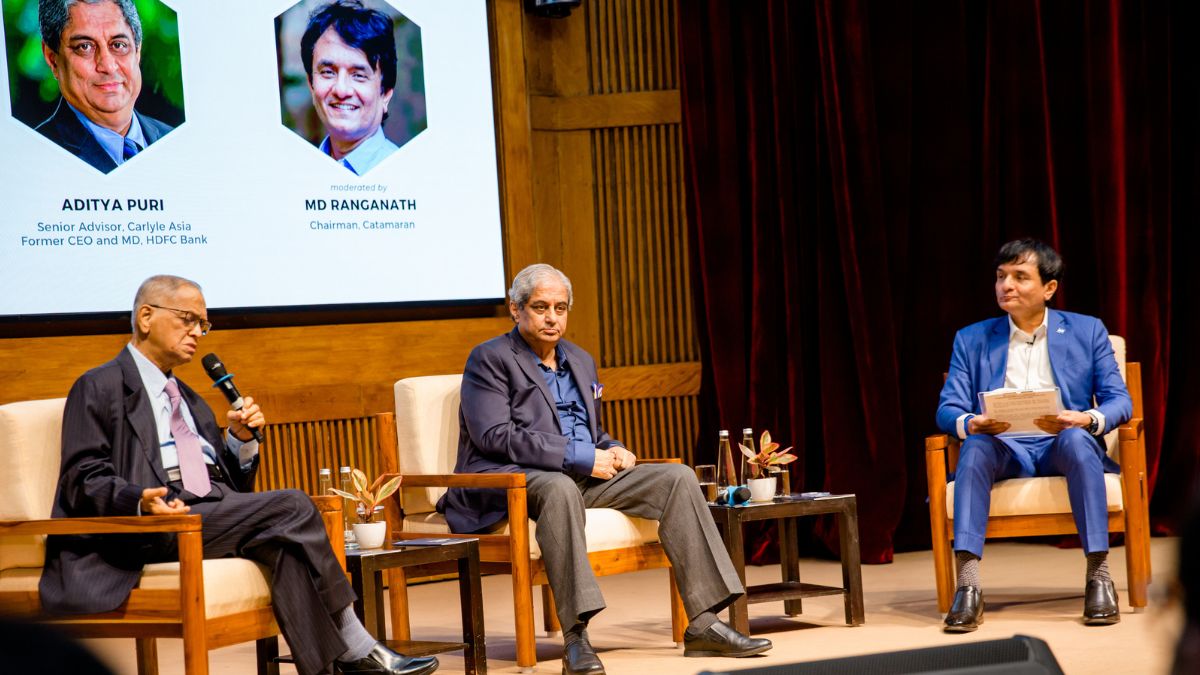
Leaders and students gathered at IIM Bangalore today as Mr. Narayana Murthy and Mr. Aditya Puri participated in a fireside chat focused on building enduring institutions in India. The session, ‘The Art of Building Legendary Companies’, was organised by Catamaran in collaboration with IIM Bangalore and moderated by M. D. Ranganath, Chairman, Catamaran.
The event was attended by entrepreneurs, business leaders, students, and faculty members, with Ms. Sudha Murty, Chairperson, Murty Trust, and Mr. U. Dinesh Kumar, Director (In-charge), IIM Bangalore, also present.
Opening the discussion, Mr. Ranganath recalled the early economic conditions under which Infosys and HDFC Bank were established. He described an era of regulatory constraints, limited access to funding, and a nascent startup ecosystem, highlighting how both organisations were built from the ground up.
The dialogue focused on the founders’ leap of faith in leaving stable jobs to create new institutions without proven business models or significant external support. Both leaders spoke about the challenge of attracting early talent, where belief in shared values and long-term purpose played a crucial role.
Speaking about Infosys’ early vision, Mr. Murthy said, “I never wanted Infosys to just be the largest in terms of revenue, net profit or market cap. I wanted it to be the most respected company in the eyes of its stakeholders.” Emphasising the importance of values, he added, “Trust is built over time through fairness and sacrifice. Leaders must be unequivocal about values and demonstrate them consistently through action.”
He noted that this approach resulted in equitable wealth creation, with Infosys stock delivering annualised returns of 47% during his tenure.
Mr. Puri, reflecting on HDFC Bank’s formative years, highlighted the need to establish strong foundations early. “If you don’t set the culture right on day one, if you don’t set the systems and your purpose on day one, you will never build a sustainable organisation. If your only objective is top line or profit, you don’t see the full picture. That cannot be the purpose of your existence,” he said.
He further stated, “The purpose of your existence is to be relevant, to be a valuable member of society, and to be respected. And respect can only be earned. The right product, the right fit, at the right price, delivered with integrity—and thereafter, whatever you earn must be fairly distributed. If you don’t want to share value with employees and want to keep it all, why should they commit themselves to the organisation?”
On building trust over time, Mr. Puri said, “Banking, for me, was never about being elite. Our purpose was to take banking to every section of society, build trust with every stakeholder, and keep reinventing ourselves as the world moved.”
He added that while markets evolve, foundational principles remain critical. “When you start your career, the fundamentals matter most—you define your market, your product, your margins, the technology and the people, and then you execute. But as the world evolves, you must evolve with it. Your values and your system of analysis must remain constant—you must simply learn to distinguish between hype and reality.”
Mr. Murthy, speaking about Mr. Puri’s achievements, said, “In my opinion, Aditya is the finest entrepreneur produced by our country post-Independence. What is truly impressive is that he succeeded in the Indian environment—taking an institution from zero revenues to a market capitalisation of nearly USD 155 billion.”
The session concluded with reflections aimed at inspiring students and early-stage founders navigating today’s competitive startup ecosystem.