Rituparno Ghosh redefined contemporary Bengali cinema with his fearless exploration of human emotions, gender identity, complex relationships, and inner conflict. A National Award-winning filmmaker, Ghosh was known for his sensitive narratives, eloquent visuals, and strong female protagonists. His films often bridged the gap between literary depth and cinematic elegance, making him a storyteller of rare insight and honesty.
What sets Ghosh apart is his ability to portray silence as powerfully as dialogue, to capture personal grief with poetic subtlety, and to turn everyday moments into emotionally charged cinema. From intimate family dramas to bold reinterpretations of literary classics, each of his films leaves a lasting impact.
This article highlights the top 5 must-watch movies directed by Rituparno Ghosh—films that not only showcase his artistic genius but also reflect the emotional and cultural richness of Indian cinema. Whether you’re new to Bengali films or an avid cinephile, these masterpieces offer a compelling entry point into the world of one of India’s most important auteurs.
1. “Unishe April” – Rituparno Ghosh’s National Award-Winning Mother-Daughter Drama
Unishe April (1994) stands as a cornerstone in Rituparno Ghosh’s filmography and played a crucial role in the revival of parallel Bengali cinema in the ’90s. The film explores the emotionally distant relationship between a renowned dancer, Sarojini (Aparna Sen), and her daughter Aditi (Debashree Roy). With a narrative set mostly over one intense night, Unishe April delves deep into generational trauma, artistic ambition, and suppressed grief. Ghosh’s restrained direction, combined with powerful performances, earned this film the National Award for Best Feature Film. It remains a masterclass in intimate, psychological drama and is essential viewing for anyone interested in character-driven narratives in Indian cinema.
2. “Chokher Bali” – A Visually Rich Adaptation of Tagore’s Feminist Classic
Chokher Bali (2003) is Rituparno Ghosh’s ambitious cinematic adaptation of Rabindranath Tagore’s novel of the same name. The film stars Aishwarya Rai as Binodini, a young widow navigating emotional and social repression in colonial Bengal. With Prosenjit Chatterjee and Raima Sen in pivotal roles, Chokher Bali is not only a visual feast with rich period detailing but also a layered exploration of female desire, betrayal, and autonomy. Ghosh skillfully retains Tagore’s complex narrative structure while infusing it with his own nuanced take on gender and morality. This film marked one of the rare and successful collaborations between Bollywood and Bengali cinema, pushing regional cinema into a wider spotlight.
3. “The Last Lear” – Rituparno Ghosh’s English Language Triumph with Amitabh Bachchan
Released in 2007, The Last Lear is one of Rituparno Ghosh’s few forays into English-language cinema and his first major Hindi film. The movie revolves around a retired Shakespearean actor, Harish Mishra (played by Amitabh Bachchan), and how a film project compels him to return to the stage. Ghosh uses a play-within-a-play structure to examine themes of identity, ageing, and artistic passion. Far from being a mainstream Bollywood narrative, The Last Lear is introspective and theatrical, with stellar performances from Shefali Shah, Preity Zinta, and Arjun Rampal. The film highlights Ghosh’s versatility and his ability to merge art-house aesthetics with pan-Indian storytelling.
4. “Raincoat” – A Subtle Portrait of Lost Love Starring Aishwarya Rai and Ajay Devgn
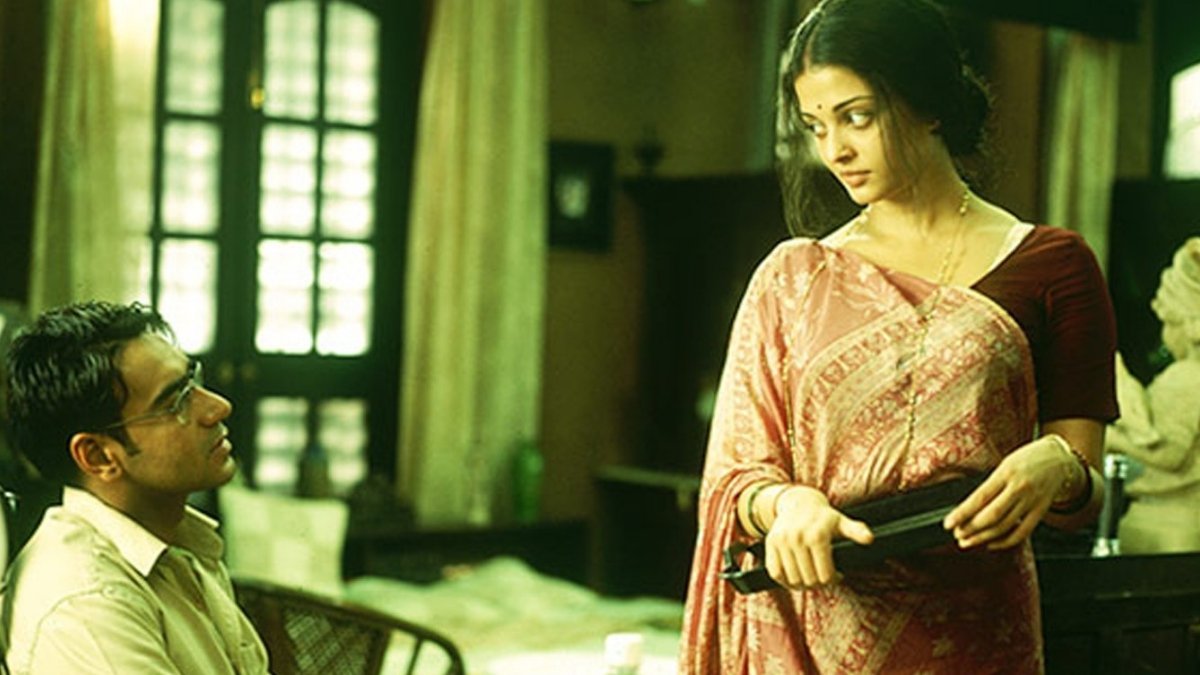
Raincoat (2004) is Ghosh’s Hindi-language adaptation of O. Henry’s short story The Gift of the Magi, recontextualized in Kolkata. Starring Ajay Devgn and Aishwarya Rai, the film follows a single rainy afternoon where two former lovers reunite after years of separation. Ghosh masterfully builds tension through silences, long takes, and subdued dialogue. Raincoat was critically acclaimed for its minimalism and melancholic mood, and it earned the National Film Award for Best Feature Film in Hindi. The film stands out for its quiet, emotional honesty and for portraying the unspoken sacrifices made in the name of love and survival—making it one of Rituparno Ghosh’s most internationally appealing works.
5. “Dosar” – Rituparno Ghosh’s Monochrome Take on Infidelity and Forgiveness
Shot entirely in black and white, Dosar (2006) is a rare visual experiment in modern Indian cinema. The story centers on Kaushik (Prosenjit Chatterjee), who survives a car accident that kills his mistress. As he recovers, his wife Kaberi (Konkona Sen Sharma) grapples with the reality of his betrayal. What follows is an emotionally layered examination of grief, loyalty, and the complexities of marital relationships. Ghosh’s decision to shoot in black and white enhances the stark emotional contrast and focuses attention on the performances, which earned wide acclaim. Dosar is one of the most mature and realistic portrayals of infidelity in Indian films and reinforces Ghosh’s status as a director deeply attuned to human vulnerability.
Rituparno Ghosh’s films transcend language and geography by delving into universal human emotions—grief, desire, guilt, and reconciliation. Whether it’s Unishe April’s family estrangement, Chokher Bali’s feminine rebellion, or Raincoat’s quiet heartbreak, each of these top 5 Rituparno Ghosh movies must be watched to understand his unique blend of lyrical storytelling and sharp social commentary. His cinema continues to resonate, educating viewers on the art of nuanced, emotionally intelligent filmmaking.