
Business Wire India
Desktop monitor shipments reached 133.4 million units in 2025, growing 4.3% year-on-year, signaling a recovery from post-pandemic disruptions. This expansion reflects the evolution of monitors into versatile, high-value tools for laptop-dominated environments, with gaming fueling interest in high-performance displays.
This press release features multimedia. View the full release here: https://www.businesswire.com/news/home/20260511832943/en/
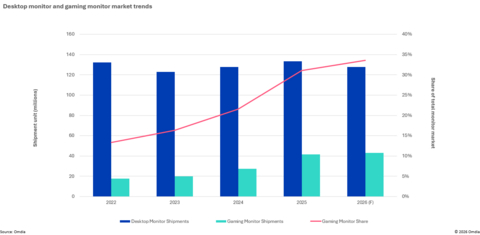
Desktop monitor and gaming monitor market trends
Gaming monitor shipments are projected to expand to 43 million units in 2026, supported by increased cost-effectiveness and added functionality. This trend reflects a shift toward specialized consumer applications and immersive entertainment experiences.
Gaming Monitors Drive Overall Shipment Expansion
Global gaming monitors shipments reached 41 million units in 2025, up 50.2% year-on-year (YoY), with gaming monitors accounting for 31.1% of total desktop monitor shipments. In 4Q25, gaming monitor shipments grew for the eleventh consecutive quarter, reaching the highest level since Omdia tracking began. These figures significantly outpace the growth rate of the conventional monitor market, establishing gaming monitors as a prominent growth segment.
Momentum is propelled by added value and enhanced functionality. Models with refresh rates above 120 Hz have gained traction rapidly, alongside improvements in responsiveness and screen size that align with evolving requirements from modern gaming content.
According to Hidetoshi Himuro, Senior Principal Analyst at Omdia, “Gaming monitors are expected to keep pace with the evolution of CPUs/GPUs and the increasing performance demands of gaming content.” Himuro noted, “A recent example illustrates this relationship. When graphics cards equipped with NVIDIA's RTX50 series enter the market, gaming monitors with higher refresh rates subsequently follow.”
OLED Technology and Dual-mode Features Accelerate Adoption
At the same time, the segment is diversifying across product tiers. OLED-equipped gaming monitors, led by Samsung’s QD‑OLED and LG’s WOLED, are gaining share thanks to perfect black levels and fast response times that elevate visual fidelity and responsiveness beyond what LCDs can deliver, though high manufacturing costs keep most OLED offerings in the premium segment.
Conversely, improved specifications at lower price points and models that leverage previous-generation technologies are meeting the needs of lightweight and first-time gamers. Together, these dynamic premium innovations at the top and value-oriented improvements at the entry level are expanding the category’s reach and reinforcing gaming monitors’ role as the preferred high-spec companion to the native notebook PC displays.
Future Outlook and Challenges
Activity in the desktop monitor market is set to intensify, particularly within the gaming monitor segment, where the future is defined by a shift toward premium display technologies. This transformation is shaped by the increasing popularity of Esports and the adoption of advanced panel technologies like OLED and QD-OLED (Quantum Dot OLED), which are capturing significant market share. Adoption is largely tied to the price-to-performance of 27-inch, 240Hz QHD (1440p), 0.03ms response time OLED models, which have gained strong traction as prices drop.
Omdia Senior Analyst Benjamin Tan commented, “Esports growth is driving a performance‑first ecosystem, concentrating demand on 240–360 Hz gaming monitors with 1ms or lower response times as pro players prioritize competitive advantage over price.”
Dual‑mode gaming monitors are also growing in popularity because they eliminate the traditional compromise for players who split time between fast‑paced competitive shooters and high‑fidelity cinematic titles. These monitors, which allow users to toggle between high-resolution (e.g., 4K @ 240 Hz) and high-refresh-rate (e.g., 1080p @ 480 Hz) modes, outperform traditional scaling by using hardware integer scaling to preserve sharpness at lower resolutions, while integrated AI enables real-time image optimization and automatic brightness adjustment.
Omdia expects dual-mode gaming monitors to grow by double digits in 2026, reflecting both future‑proofing and upgrade cycles. Gamers can use the high‑refresh, lower‑resolution mode today to maximize smoothness with current GPUs, while keeping high-resolution modes available for PC component upgrades.
Despite strong demand trends, several challenges may continue to limit broader market penetration. High manufacturing costs for OLED panels make high-end monitors less accessible to budget-conscious consumers, limiting market penetration. OLED burn-in concerns also persist despite improvements. Furthermore, supply chain and material volatility – stemming from semiconductor shortages, and geopolitical tensions – can disrupt production schedules and drive up costs, adding further uncertainty to the industry.
About Omdia
Omdia, part of TechTarget, Inc. d/b/a Informa TechTarget (Nasdaq: TTGT), is a technology research and advisory group. Our deep knowledge of tech markets grounded in real conversations with industry leaders and hundreds of thousands of data points, make our market intelligence our clients’ strategic advantage. From R&D to ROI, we identify the greatest opportunities and move the industry forward.
View source version on businesswire.com: https://www.businesswire.com/news/home/20260511832943/en/

Disclaimer: The above press release comes to you under an arrangement with Business Wire India. Publication takes no editorial responsibility for the same.